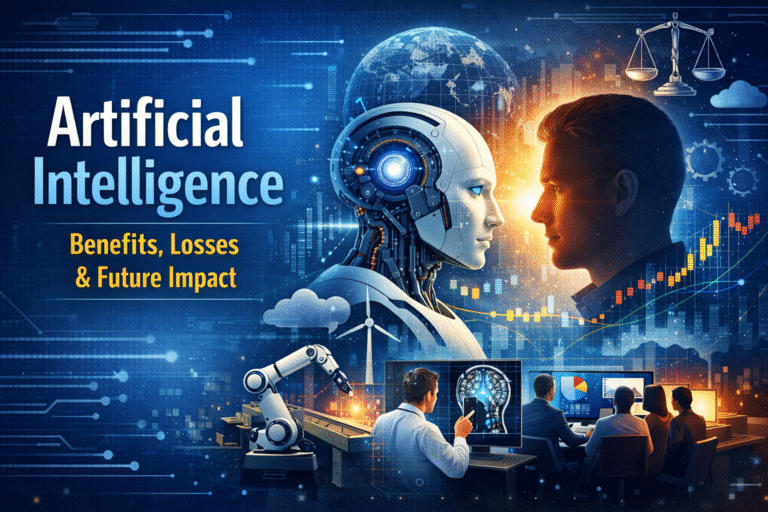
What is Artificial Intelligence ?
Artificial Intelligence (AI) refers to the ability of machines and computer systems to perform tasks that normally require human intelligence. These tasks include learning from experience, problem-solving , decision-making, understanding language, and recognizing patterns. In recent years, AI has become an integral part of our daily lives, influencing sectors such as healthcare, education, law, business, and governance. While AI offers numerous advantages, it also brings certain risks and challenges that must be carefully managed.
Benefits of Artificial Intelligence
1. Increased Efficiency and Productivity
AI systems can perform repetitive and time-consuming tasks much faster and more accurately than humans. In industries, AI helps automate processes, reduce human error, and improve overall productivity.
2. Healthcare Advancements
AI assists doctors in diagnosing diseases, analyzing medical images, predicting health risks, and even performing robotic surgeries. It helps save lives by enabling early detection and personalized treatment plans.
3. Improved Decision-Making
AI analyzes large volumes of data to provide accurate insights and predictions. In finance, law, and business, AI supports better decision-making by identifying patterns that humans may overlook.
4. Education and Learning
AI-based tools provide personalized learning experiences, online tutoring, and smart assessments. Students can learn at their own pace, improving accessibility and quality of education.
5. Convenience in Daily Life
Virtual assistants, recommendation systems, navigation apps, and smart homes make everyday tasks easier and more efficient, enhancing overall quality of life.
Losses and Disadvantages of Artificial Intelligence
1. Job Displacement
One of the major concerns is that AI may replace human jobs, especially in sectors involving routine and manual work. Automation can lead to unemployment if reskilling is not addressed.
2. Dependence on Machines
Excessive reliance on AI can reduce human creativity, critical thinking, and decision-making abilities, making people overly dependent on technology.
3. Ethical and Privacy Issues
AI systems collect and analyze vast amounts of personal data, raising concerns about data privacy, surveillance, misuse, and lack of transparency in decision-making.
4. Bias and Discrimination
If AI systems are trained on biased data, they may produce unfair or discriminatory outcomes, particularly in areas like recruitment, policing, and legal decisions.
5. High Cost and Complexity
Developing, maintaining, and regulating AI systems requires significant financial investment and technical expertise, which may not be accessible to all countries or organizations.
Future Impact of Artificial Intelligence
1. Transformation of Work and Economy
AI will reshape the job market by creating new roles that require digital and analytical skills. Human-AI collaboration will become the norm rather than complete replacement.
2. Smarter Governance and Law
In the future, AI may assist in legal research, case analysis, and policy formulation. However, human judgment will remain essential to ensure justice and fairness.
3. Sustainable Development
AI can help address global challenges such as climate change, resource management, and disaster prediction by enabling smarter and faster solutions.
4. Ethical AI and Regulation
Governments and institutions are expected to develop strict laws and ethical frameworks to ensure responsible use of AI, protecting human rights and dignity.
5. Human-Centric Innovation
The future of AI lies in making technology more transparent, explainable, and aligned with human values, ensuring that AI serves humanity rather than controls it.
Conclusion
Artificial Intelligence is a powerful tool that has the potential to transform society positively. Its benefits in efficiency, healthcare, education, and governance are immense. However, the risks of job loss, ethical concerns, and over-dependence cannot be ignored. The future impact of AI will largely depend on how responsibly it is developed, regulated, and used. A balanced approach—combining technological advancement with ethical considerations and human oversight—will ensure that AI becomes a boon rather than a burden for humanity.